
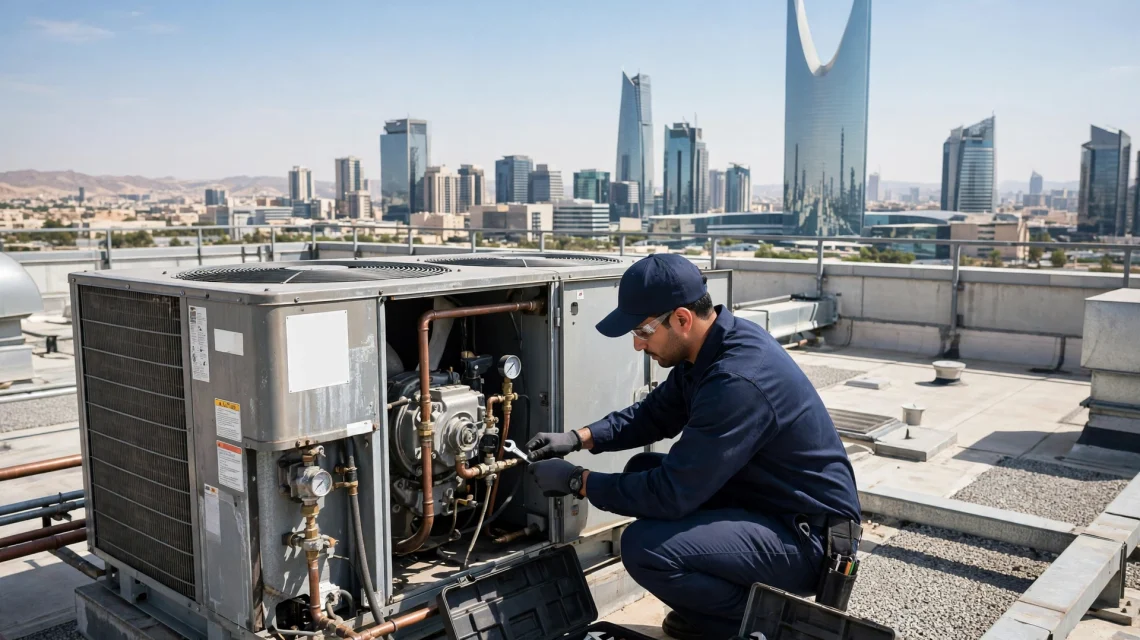
A building in Riyadh does not stay working by itself. The air conditioning runs through a summer where the temperature passes 45 degrees. The plumbing serves hundreds of people a day. The lifts, the pumps, the generators, the fire systems — all of it needs people who know what they are doing, and who show up on schedule.
When maintenance breaks down, it does not break down quietly. A failed chiller in a Riyadh shopping mall in July is an emergency, not an inconvenience. A blocked drain in a residential compound becomes a complaint from fifty families before lunch. That is why hiring maintenance workers is a different decision from hiring construction workers: construction ends, maintenance never does.
This guide is for the people who have to make that decision — facility managers, property managers, contractors, hotel and hospital operations managers, and business owners in Riyadh. It covers the types of maintenance workers you actually need, where they work, what Saudi compliance involves, what drives the cost, and how hiring through a manpower supply company works.
Quick Answer: How to Hire Maintenance Workers in Riyadh
If you need the short version: decide which trades you need (electrical, mechanical, HVAC, plumbing, or general facility work), work out how many workers and for how long, check that any supplier can show valid Iqama, Qiwa and GOSI documentation for its workers, and ask for a quote based on your actual scope — not a generic rate card. A reputable manpower supplier in Riyadh will ask about your site, your shift pattern and your skill requirements before quoting, because the price depends on all three.
NR Dream Contracting is a manpower supply company based in Riyadh. Alongside maintenance workers, it supplies construction, welding, electrical, plumbing and general workers. Its dedicated maintenance workers service in Riyadh covers the trades in this guide. If you already know your numbers, skip ahead and Request a Quote — trade, headcount, site location and start date are all we need to start.
What Counts as a Maintenance Worker?
“Maintenance worker” covers more trades than most people realise. The right crew depends entirely on the building and the problem. Some jobs also need welding and fabrication support alongside the core trades. The main categories in Riyadh are:
Electrical maintenance technicians
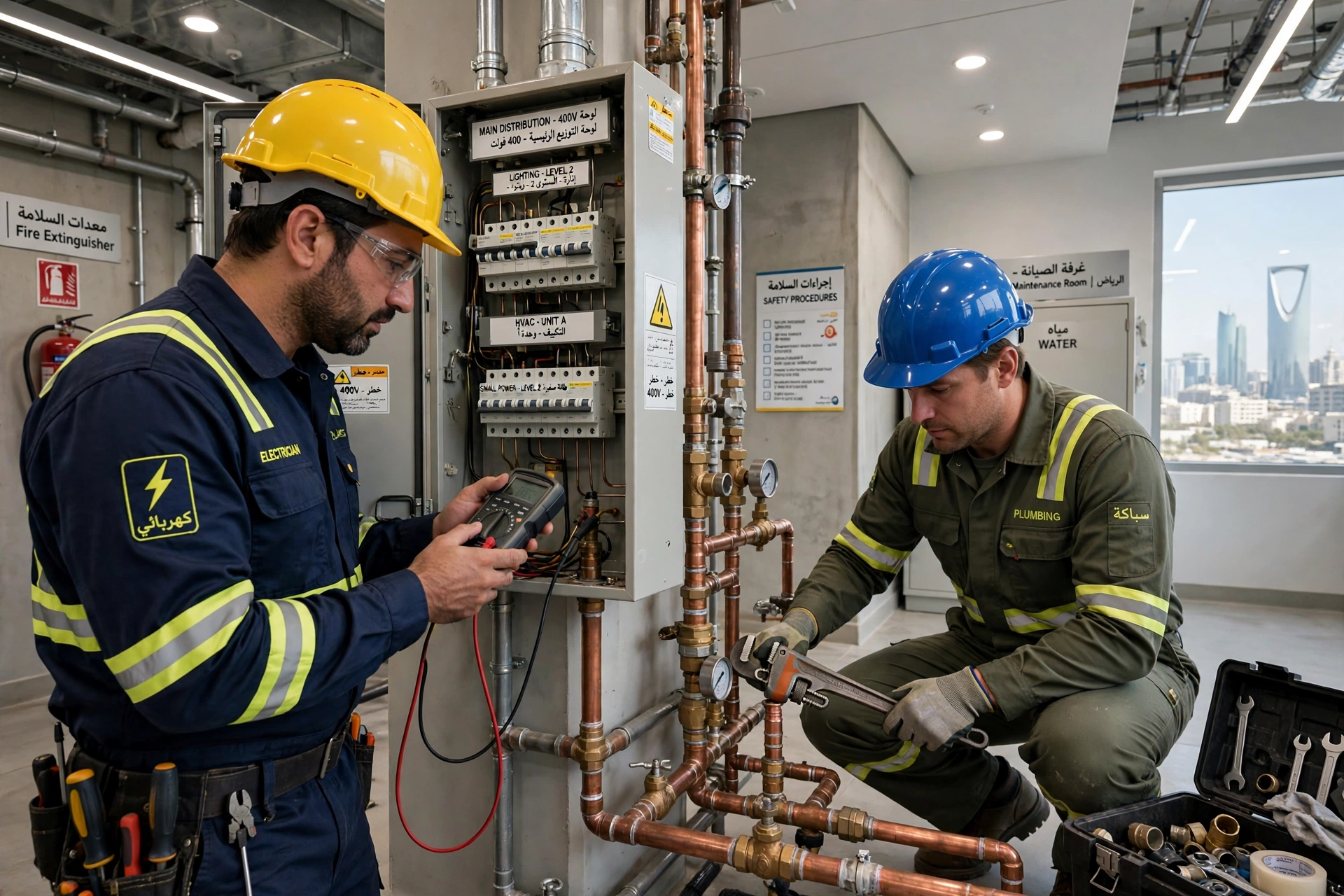
Handle lighting, power distribution, wiring, control panels, emergency lighting and small installations. In a facility setting this means everything from replacing a failed circuit breaker to planned testing of distribution boards. If your site has already used electricians for installation work, the maintenance electrician is the person who keeps that installation safe afterwards. (See also: our guides to hiring electrical workers in Riyadh and electrician costs in Riyadh.)
Mechanical and HVAC technicians
In Riyadh, this is the trade that matters most. HVAC technicians service chillers, air handling units, split systems, ductwork and ventilation — the equipment that keeps a building habitable through the summer. Mechanical technicians look after pumps, motors, compressors and generators. A site that loses its cooling in August does not have a comfort problem; it has a shutdown problem.
Plumbing maintenance workers
Deal with water supply, drainage, fixtures, pumps and water tanks. In Riyadh’s compounds, malls and hotels, plumbing maintenance is constant work: leaks, blockages, pump failures and fixture replacements. Our guide to hiring plumbing workers in Riyadh covers this trade in detail.
General facility and multi-skilled workers
The people who do the work that does not fit neatly into one trade: painting touch-ups, tiling repairs, carpentry fixes, basic civil work, cleaning support and helping the skilled technicians. Every maintenance team needs them — a skilled electrician should not be spending half his day carrying materials or waiting for a helper.
Supervisors and facility support staff
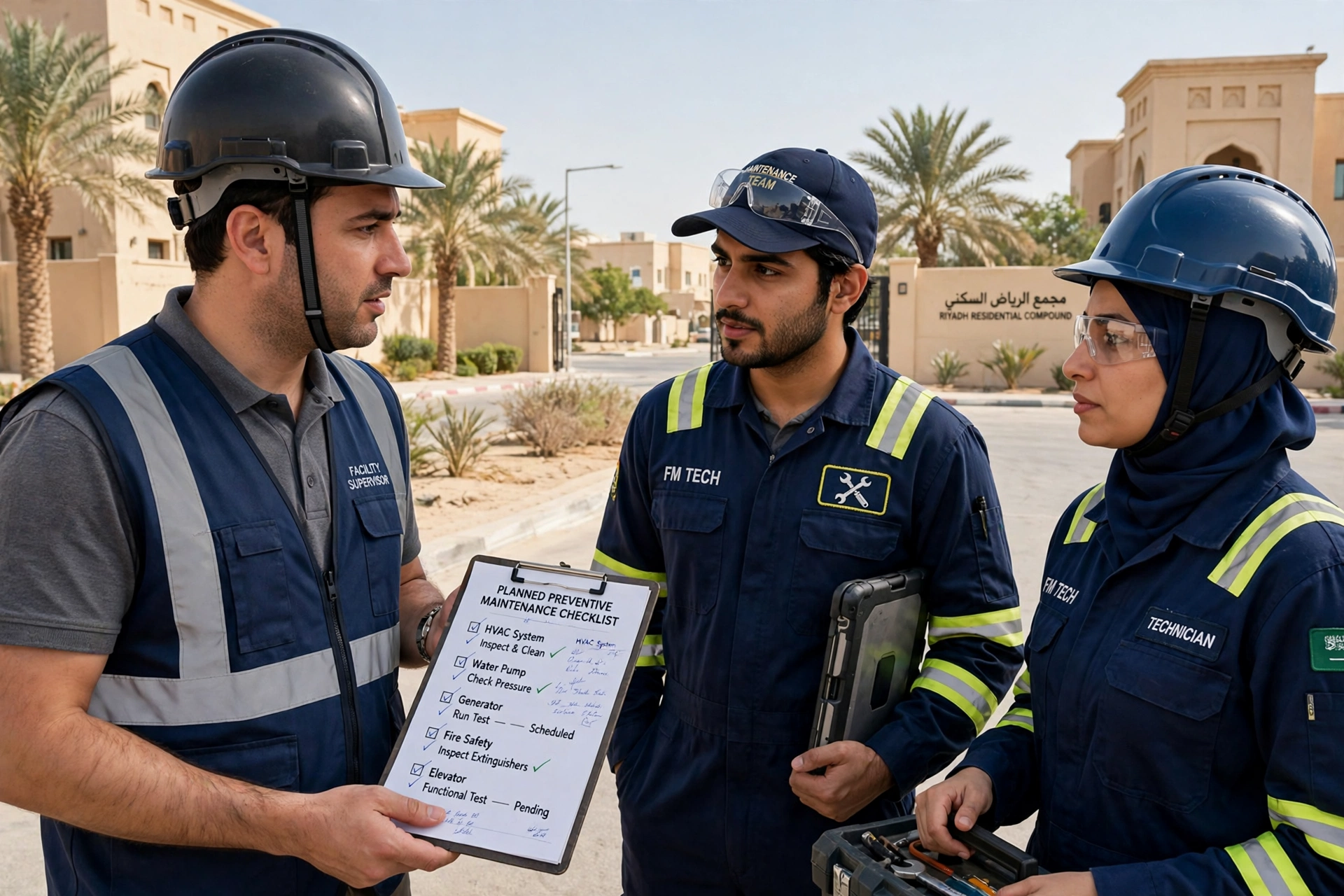
For larger sites — a hospital, a mall, a residential compound — someone has to plan the work, hold the maintenance schedule, keep spares in stock and report to the client. A maintenance supervisor with a planned preventive maintenance (PPM) schedule is what separates a site that runs from a site that reacts.
Most real maintenance jobs need a mix, not a single trade. A residential compound might need two electricians, one HVAC technician, one plumber and two general workers. A hospital needs more, with stricter documentation. The mix is the first thing to get right — and the first thing a good supplier will ask you about.
Where Maintenance Workers Are Needed in Riyadh
Maintenance demand in Riyadh is not tied to one sector. It follows the buildings, and Riyadh is building and operating more of them every year under Vision 2030:
- Residential compounds and apartment buildings — continuous plumbing, electrical and HVAC work, plus common-area upkeep. The largest single source of steady, long-term maintenance demand.
- Shopping malls and commercial towers — HVAC and electrical dominate, with strict uptime expectations. A failed escalator or a dark food court costs money by the hour.
- Hospitals and clinics — the most demanding environment: medical gas, backup power, sterile-area HVAC, and maintenance that often has to happen without interrupting patient care.
- Hotels — guest-room maintenance, kitchen equipment, laundry, pools and public areas, with work scheduled around occupancy.
- Industrial facilities and warehouses — mechanical maintenance, generators, compressors, material handling equipment, and planned shutdowns.
- Government buildings, ministries and banks — long-term facility management contracts with formal documentation and compliance requirements.
- Giga-project and Expo 2030 sites — large, fast-moving sites where maintenance crews support construction-phase facilities as well as completed buildings.
The point for anyone hiring: maintenance is not project work with an end date. It is an ongoing operation, usually on a monthly or annual arrangement, and the hiring decision should be made with that in mind. A supplier who can only fill a one-week gap is not the same as a supplier who can staff your site for a year.
Why Demand for Maintenance Workers in Riyadh Is So High
Three things are driving it at once. First, Riyadh’s building stock keeps growing — new towers, compounds, malls and industrial zones, all of which need maintaining from the day they open. Second, the Vision 2030 programme, including Expo 2030 preparation, has raised the standard: facilities are expected to run properly, not just stand up. Third, older buildings are ageing into their heavy-maintenance years — chillers, lifts and pipework installed a decade ago are now reaching the point where reactive fixes are no longer enough.
The result is that good maintenance technicians in Riyadh are in steady demand, and the employers who plan ahead — with a proper crew mix and a real maintenance schedule — get the better workers. The ones who wait for a breakdown and then call around in a panic pay for the urgency twice: once in the emergency, and once in the disruption.
Hiring Directly vs Using a Manpower Supply Company
There are two ways to staff maintenance in Riyadh, and the right choice depends on how long you need people and how much administration you want to carry.
Hiring directly means you recruit, sponsor visas, manage Iqama and GOSI, handle accommodation and transport, and carry the workers on your own payroll. That makes sense if you need a large, permanent maintenance team for years and you have an HR function to manage it. It is slower to set up and harder to scale up or down.
Using a manpower supply company means the supplier employs the workers and provides them to your site under an agreed arrangement. You describe the trades, headcount, location, duration and shift pattern; the supplier selects, documents and deploys the workers. This is the practical option when you need workers quickly, when headcount changes with the season or the contract, or when you want to avoid building a recruitment and visa operation for a support function. It is also the standard route for short-term cover — Ramadan schedules, summer peak load, a planned shutdown — and for sites that need a mixed crew rather than one trade.
Neither route is “better” in the abstract. The question is which one fits your site, your timeline and your tolerance for paperwork. If you are weighing it up, our broader guide to manpower supply companies in Riyadh explains the model in full, and the construction workers hiring guide covers the same decision from the construction side.
How Manpower Supply Works for Maintenance Crews
The process is straightforward, and any supplier who cannot explain it clearly is a warning sign. At NR Dream Contracting it runs in five steps:
- Share your requirement. Tell us the worker categories, how many of each, the site location in Riyadh, the duration, the shift pattern and the planned start date. A hospital night shift and a compound day shift are different requirements — say so upfront.
- Requirement review. We go through the job description for each category so there is a clear, shared understanding of what each worker is expected to do — including any certifications or experience the site requires.
- Worker selection. Suitable workers are identified from the available workforce, matched to the trade and the skill level the job needs — a senior HVAC technician for chiller work is not interchangeable with a general helper.
- Documentation and coordination. Iqama, Qiwa, GOSI and any site-specific requirements (gate passes, safety induction, medical) are organised before deployment. This is the step that gets skipped by bad suppliers, and it is the step that causes problems later.
- Deployment and ongoing support. Workers are mobilised to site, and the arrangement is reviewed if your requirement changes — headcount up or down, a new trade added, a shift pattern changed.
Saudi Compliance: Iqama, Qiwa, Nitaqat and GOSI in Plain Terms
You do not need to be a lawyer to hire maintenance workers in Riyadh, but you do need to know the four names that come up in every legitimate arrangement. This is general information, not legal advice — confirm the current rules with your HR team or the relevant Saudi authority.
- Iqama: the residence permit every expatriate worker must hold. It must be valid, and the worker’s profession on it should match the work they do. A supplier should be able to confirm Iqama status for every worker it deploys — ask, and do not accept a vague answer.
- Qiwa: the Ministry of Human Resources and Social Development’s platform for employment contracts, transfers and workforce management. Legitimate employment arrangements in Saudi Arabia run through Qiwa. If a supplier cannot explain how its workers are registered, that is a problem.
- Nitaqat (Saudization): the programme that sets the proportion of Saudi nationals a company must employ, by sector and size. It affects how suppliers structure their workforce and which roles they can fill with expatriate workers. It is a reason to use an established supplier rather than an informal one — compliance is their job, not yours to discover later.
- GOSI: the General Organization for Social Insurance. Workers must be registered, and contributions must be paid. GOSI registration is part of what separates a formal workforce from an informal one.
A practical rule: if a supplier is vague about any of these four, walk away. The cost of a compliance problem — a worker stopped at a site gate, a failed inspection, a contract dispute — is always higher than the saving from the cheapest quote.
What Maintenance Workers Cost in Riyadh: The Factors
This guide does not publish rates, because rates are not fixed — and any guide that gives you a single number for “a maintenance worker in Riyadh” is either out of date or selling something. What we can do honestly is explain what drives the cost, so you can judge any quote you receive:
- Trade and skill level. A senior HVAC technician with chiller experience costs more than a general helper. That is not a markup — it is a different worker. The most expensive mistake in maintenance hiring is paying a skilled rate for unskilled work, or the reverse: hiring a helper to do a technician’s job and paying for the damage later.
- Headcount and duration. A 12-month contract for ten workers prices differently from a two-week emergency deployment for two. Longer commitments and larger teams are usually more economical per worker.
- Shift pattern and hours. Night shifts, weekend cover, 24/7 standby and overtime all add cost. Be honest about the hours when you ask for a quote — a supplier who prices a day shift and then discovers a night shift will re-price it anyway.
- Site location and conditions. A site in central Riyadh with easy access is different from a remote industrial site that needs transport and accommodation. Summer outdoor work, high-rise work and hospital environments all carry their own requirements.
- Documentation and compliance. Properly documented, insured and GOSI-registered workers cost more than informal labour — and for good reason. The cheapest quote in the market is usually the one that has skipped something.
- Accommodation and transport. Whether these are included in the rate or charged separately changes the comparison completely. Always ask what a quote includes before comparing two numbers.
The right way to compare suppliers is to get a quote on the same scope — same trades, same headcount, same hours, same inclusions — and then judge on documentation, screening and reliability, not just the headline number.
7 Questions to Ask Any Maintenance Manpower Supplier
Before you sign anything, ask these. A good supplier will answer them directly; a bad one will change the subject.
- Can you show me valid Iqama, Qiwa and GOSI documentation for the workers you will deploy?
- How do you screen or test your technicians — and can you show me evidence, not just a claim?
- What happens if a worker is not suitable? How quickly can you replace them?
- Who manages the workers day to day — you, or me? And who is the single point of contact?
- What is included in the rate — accommodation, transport, insurance, overtime? What is not?
- How quickly can you mobilise, and what could delay it?
- Can you give me a reference from a facility or site similar to mine in Riyadh?
If a supplier answers all seven clearly, you are probably in safe hands. If it cannot answer the first two, do not proceed — whatever the price.
Common Mistakes When Hiring Maintenance Workers in Riyadh
- Hiring one trade to cover every job. An electrician is not a plumber, and a plumber is not an HVAC technician. Mixed crews cost more upfront and far less over a year.
- Choosing on price alone. The cheapest quote usually means undocumented workers, no screening, or no replacement if someone leaves. The true cost shows up in the second month.
- No planned preventive maintenance schedule. Hiring workers without a PPM plan means they spend their time reacting to breakdowns instead of preventing them. A maintenance crew without a schedule is just a repair crew.
- Skipping the documentation check. Iqama, Qiwa and GOSI are not paperwork for its own sake — they are what keep your site compliant and your workers on site.
- No single point of contact. When the supplier, the site manager and the workers all report to different people, small problems become big ones. One contact, one escalation route.
- Forgetting the summer. Maintenance demand peaks when the heat does. Plan your crew before summer, not during it — and make sure HVAC cover is in place before the temperature climbs.
Maintenance Workers in Riyadh — FAQs
How do I hire maintenance workers in Riyadh?
Decide which trades you need, how many workers, and for how long. Then either recruit directly (slower, more administration) or use a manpower supply company in Riyadh, which selects, documents and deploys workers to your site. Share your full requirement — trade, headcount, location, duration, shift pattern — and ask for a quote on that exact scope.
What types of maintenance workers can I hire in Riyadh?
The main categories are electrical maintenance technicians, mechanical and HVAC technicians, plumbing maintenance workers, general facility and multi-skilled workers, and maintenance supervisors. Most sites need a mix — for example, a residential compound might need electricians, an HVAC technician, a plumber and general helpers.
Do maintenance workers in Riyadh need an Iqama?
Yes. Every expatriate worker in Saudi Arabia must hold a valid Iqama, and their registered profession should match the work they do. Workers should also be registered on Qiwa and with GOSI. Any legitimate supplier should be able to confirm this documentation before deployment.
How much do maintenance workers cost in Riyadh?
There is no single fixed rate — cost depends on the trade, skill level, headcount, contract duration, shift pattern, site location and what is included (accommodation, transport, insurance). Get quotes on the same scope from each supplier and compare what is included, not just the headline number.
Can I hire maintenance workers for a short-term project in Riyadh?
Yes. Manpower supply companies in Riyadh arrange workers for project-based and defined periods, including short-term cover for shutdowns, seasonal peaks and emergency repairs. Share the dates and scope as early as possible — availability depends on the trades and numbers you need.
What is the difference between a maintenance worker and a construction worker?
A construction worker builds something new — the job ends when the project ends. A maintenance worker keeps an existing building running — the work is ongoing, usually on a monthly or annual arrangement, and it follows a planned schedule rather than a project timeline. The skills overlap in some trades (electrical, plumbing), but the hiring decision is different.
The Bottom Line
Maintenance is the part of a building nobody notices until it fails — and then it is the only thing anyone notices. The employers who get it right in Riyadh do the same few things: they hire a proper mix of trades, they check documentation before deployment, they work to a planned preventive maintenance schedule, and they choose their supplier on reliability rather than the lowest number on a quote.
If you are planning maintenance cover for a compound, mall, hospital, hotel or industrial site in Riyadh, start with the scope — trades, headcount, hours — and get a quote on that. NR Dream Contracting supplies maintenance, construction, welding, electrical, plumbing and general workers across Riyadh, and we are happy to quote on your actual requirement rather than a generic rate card. Request a Quote with your trade, headcount, site location and start date, and we will come back with a plan — or read our construction workers hiring guide and our guide to manpower supply companies in Riyadh to compare your options first.