
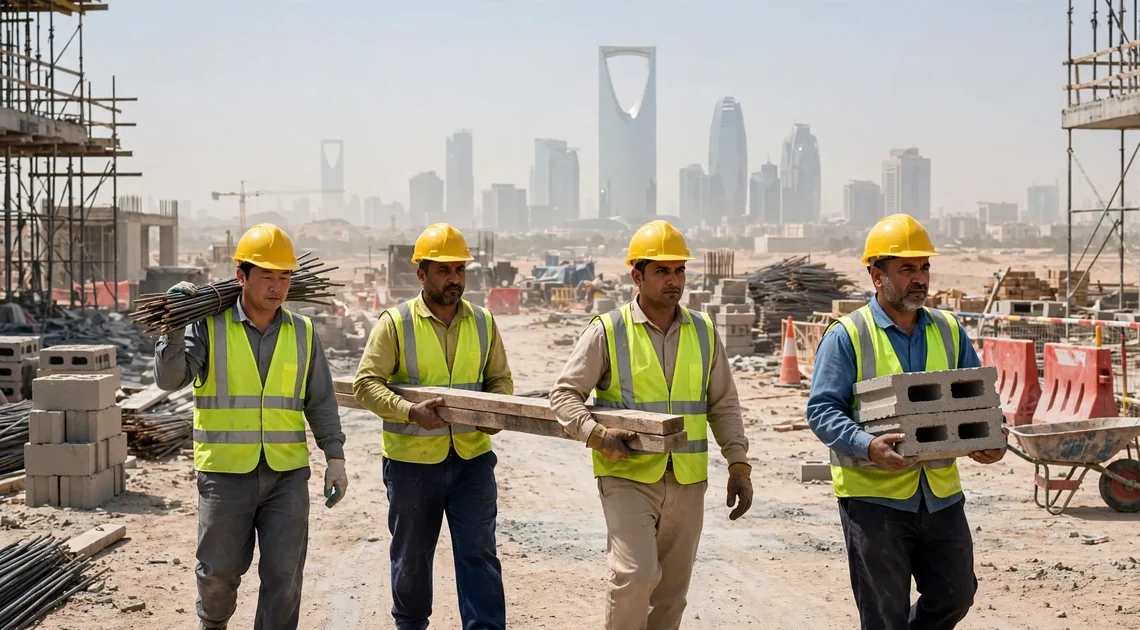
Every construction site, warehouse, and facility in Riyadh runs on people whose job title rarely makes the org chart: general workers. They carry the materials, clear the site, load the trucks, clean the building, and keep skilled tradesmen working instead of waiting. When a project falls behind in Riyadh, the cause is very often not a missing engineer — it is a missing crew of helpers.
Yet hiring general workers is where many employers make their costliest mistakes. They hire too late, hire the wrong type of helper for the job, or discover at the gate that a worker’s Iqama cannot be transferred. This guide is written for the employer side: what general workers actually do, where to find them in Riyadh, whether to hire directly or through a manpower supplier, what compliance to check before anyone starts, and what drives the cost. NR Dream Contracting’s general workers supply service provides screened crews for all of these roles.
What counts as a general worker?
A general worker — also called a helper, general labourer, or unskilled worker — is an entry-level worker whose job relies on physical effort and following instructions, not a trade licence or formal certificate. That distinction matters, legally and practically: a general worker supports skilled workers, but does not do licensed trade work on their own. A helper passes tools to the electrician; the electrician wires the panel and signs it off.
In Riyadh, general workers fall into four recognisable families. Knowing which one you need saves weeks of hiring the wrong people.
| Worker type | Main tasks | Typical setting |
|---|---|---|
| Construction helper | Carrying materials, mixing cement and mortar, assisting masons and electricians, clearing debris, site cleanup | Building sites, giga-projects, Metro extensions, Qiddiya and Diriyah works |
| Cleaning / facility helper | Office cleaning, mall housekeeping, waste collection, light maintenance support | Government buildings, banks, corporate towers in Olaya and KAFD, hospitals, malls |
| Warehouse / loading helper | Stacking pallets, sorting deliveries, scanning stock, loading and unloading trucks | Logistics hubs, Second Industrial City, distribution centres on the ring roads |
| Retail back-of-house helper | Restocking shelves, collecting trolleys, breaking down cardboard, organising stockrooms | Supermarkets, shopping centres, retail warehouses |
Construction helpers do the heaviest physical work, in heat and dust, but usually get the most overtime when a project hits a deadline. Cleaning and facility helpers work indoors on fixed shifts — often split between early morning and evening, before and after office hours. Warehouse helpers work in bulk at distribution centres and are among the easiest to hire quickly. Retail helpers rarely deal with customers directly, which suits workers still building confidence in Arabic.

Where the demand is in Riyadh
Riyadh’s demand for general workers is not a short spike. It is structural, driven by projects that run for years:
- Giga-projects and infrastructure: Qiddiya, Diriyah, Riyadh Metro extensions, and Expo 2030 and World Cup 2034 preparations keep construction helpers in steady demand across the city and out toward the new development zones.
- Facilities and cleaning: the ministries, banks, and corporate headquarters clustered in Olaya and the King Abdullah Financial District run on cleaning and facility crews every day of the year.
- Warehouses and logistics: the Second Industrial City and the logistics zones along the Eastern Ring Road hire pickers, packers, and loaders in bulk, with sharp peaks around Ramadan, Hajj season, Riyadh Season, and major sale events.
- Retail: supermarkets and malls need back-of-house crews continuously, with extra hands before Ramadan and national holidays.
The practical consequence for an employer: general-worker demand does not disappear between projects, it moves between districts. A contractor who plans hiring around one site will always be scrambling. A contractor who keeps a relationship with a manpower supplier can move crews where the work is.

Direct hire vs manpower supply: which fits your job?
This is the first decision, and it should be made before you post a single vacancy.
Hire directly when: the work is permanent and ongoing (a facility contract with a fixed headcount for a year), you have an HR team that can manage Iqama transfers, GOSI, medicals, and accommodation, and you want the same faces on site every day. Direct hire gives you control — and the full administrative burden that comes with it.
Use a manpower supplier when: the need is project-based or seasonal, the headcount swings from week to week, you need workers fast, or you do not want to carry sponsorship, payroll, and compliance for a short-term crew. The supplier sponsors and manages the workers and deploys them to your site; you pay for the labour you use and can scale the crew up or down with the project.
Many Riyadh employers use both: a small directly hired core crew for continuity, plus supplied workers to absorb peaks. That mix is usually the cheapest way to never be short-handed.
For a fuller comparison of suppliers, see our guide to manpower supply companies in Riyadh. For skilled trades, the same decision plays out differently — our construction workers hiring guide and maintenance workers guide cover those roles.
How to hire general workers in Riyadh: a 5-step process
Step 1 — Define the job before you look for people
‘General worker’ is not a job description. Write down, in one paragraph: the tasks, the site or building, the shift pattern, whether the work is indoor or outdoor, the physical demands, and how long the job lasts. A warehouse loader and a construction helper are both general workers — but they need different stamina, different hours, and different onboarding. Employers who skip this step hire whoever is available and discover the mismatch on day two.
Step 2 — Decide the headcount and the timeline
Work out how many workers you need, for how many weeks, and when the peak hits. General workers hire fast — often within days — but only if the paperwork is ready. The most common delay is not finding people; it is finding people whose documents are in order. Plan the start date backwards from the documents, not from the project date.
Step 3 — Check the documents before the interview
For expatriate workers, the essentials are a valid Iqama with transferable sponsorship, a passport copy, and a medical fitness certificate. A non-transferable Iqama blocks most site and warehouse hiring, so confirm transferability first — it is the single most common reason a hire falls through at the gate. Saudi nationals need a valid national ID, and for some roles a social insurance registration. Ask for the documents before you spend time interviewing; a worker who cannot legally start is not a candidate.
Step 4 — Interview for reliability, not a CV
General work is entry-level and most candidates have no formal work history to judge. The interview should answer three questions: can this person handle the physical work, do they have any relevant site experience, and can they start when you need them? Ask about previous sites or employers, check references where they exist, and be ready to decide fast — reliable workers who can start tomorrow are hired by someone else by next week.
Step 5 — Confirm the contract before the first shift
Before anyone starts, put the terms in writing: working hours, overtime, accommodation and transport, who pays for Iqama renewal, and whether pay is daily or monthly. Get the offer in writing where possible and keep a copy of everything signed. Most disputes over general-worker hiring trace back to a verbal promise made at the gate and remembered differently a month later.
Compliance: the checks that protect you
Hiring general workers in Saudi Arabia comes with rules that are simple to follow and expensive to ignore. These are the ones that matter most for this category:
- Iqama and sponsorship. Every expatriate worker must hold a valid Iqama linked to a sponsor on Qiwa. If you hire directly, you are the sponsor. If you use a supplier, the supplier sponsors the worker — confirm that in writing.
- Qiwa and transfer. Sponsorship transfers and employment contracts run through the Qiwa platform. A worker whose transfer is not completed in Qiwa is not legally your worker, whatever anyone told you at the gate.
- GOSI and health insurance. Workers must be enrolled in GOSI (social insurance) and covered by health insurance — medical cover is a legal requirement, and wages should be paid into a Saudi bank account tracked under the Wage Protection System (WPS).
- Medical fitness. A medical fitness certificate is standard for site and warehouse roles. Confirm it is current before deployment, not after.
- Saudization (Nitaqat). Nationalisation quotas apply differently by sector and company size, and contracting and cleaning are among the sectors where quotas push employers to hire Saudi nationals for some roles. Saudi nationals can also register with the Human Resources Development Fund (HRDF) for wage support and short training, which lowers the cost of hiring them. Check your company’s current Nitaqat band before finalising the mix.
- Contracts and hours. Labour law requires a clear employment contract stating wage, shift hours, and end date. Daily-wage arrangements are common for construction and loading work, but the rate and payment terms should still be agreed in writing before the first shift.
None of this is complicated — but every item on the list is a reason a worker can be turned away at a site gate or a project can be fined. A good manpower supplier handles all of it before deployment, which is a large part of what you are paying for.
What drives the cost of general workers in Riyadh?
NR Dream Contracting does not publish fixed rates, because the cost of a general worker genuinely varies with the job. These are the factors that move it:
- Worker type and setting. Construction and warehouse helpers typically cost more than cleaning helpers, because the work is heavier and the hours less predictable. Indoor facility work is usually steadier and cheaper to staff.
- Daily wage vs monthly contract. Daily-wage hiring pays only for days worked and carries no benefits, but you arrange everything yourself. Monthly contracts usually bundle shared accommodation and site transport, and suit anyone who needs a predictable crew.
- Accommodation and transport. Whether the employer provides shared housing and a bus to site — or pays a housing allowance instead — is often the largest single swing in total cost. Always compare the full package, not the headline wage.
- Overtime. Construction helpers on a project deadline earn significant overtime. A quote that ignores overtime will look cheap on paper and expensive in practice.
- Volume and duration. A 50-worker crew for six months costs less per worker than five workers for two weeks — mobilisation, medicals, and administration are spread over more heads and more time.
- Nationality mix and Saudization. The Saudization band your company sits in can change which roles must be filled by Saudi nationals, and HRDF wage support can offset part of that cost.
- Supplier margin vs direct-hire overhead. A supplier’s rate includes sponsorship, payroll, compliance, and replacement cover. Direct hire looks cheaper per worker until you add HR time, Iqama and medical costs, and the cost of a worker who leaves mid-project with nobody to replace them.
Ask any supplier for a quote that breaks these out — wage, accommodation, transport, overtime treatment, and what happens when a worker is absent or leaves. A quote that hides them is not cheaper; it is incomplete. For comparison, skilled-trade pricing follows a different structure — see our guide to electrician costs in Riyadh. To request a quote from NR Dream, see our Request a Quote page.
How to screen a manpower supplier for general workers
Not every supplier is set up for high-volume general labour. Ask these seven questions before you commit:
- Can you show me the workers’ documents before deployment? Iqama status, transferability, medical certificates — a supplier who cannot show them has not checked them.
- Who sponsors the workers, and is it in writing? The answer should be the supplier, on a contract you can read.
- How fast can you replace a worker who leaves or is absent? General-worker crews churn. A supplier with a real bench replaces within days; one without will leave your site short.
- What is included in the rate? Accommodation, transport, overtime, medical, GOSI — get it itemised, or you will discover it later.
- Do you supply this type of worker already, and where? A supplier strong in skilled trades is not automatically strong in high-volume general labour. Ask for current deployments, not old logos.
- How do you handle site safety? Even unskilled work needs basic safety induction, PPE, and a supervisor who checks it. Ask what the induction covers.
- What happens at the end of the project? Notice periods, demobilisation, and who handles the workers afterwards should be agreed before the first shift, not negotiated at the last one.
Common mistakes employers make
Hiring on price alone. The cheapest daily rate usually means no accommodation, no transport, no replacement cover, and no documents checked. The first absent worker or gate rejection costs more than the saving.
Treating all helpers as interchangeable. A retail stockroom helper will not last a week carrying cement in August heat. Match the worker type to the job, or budget for the turnover.
Starting recruitment the week the project starts. Documents take days; a good crew takes longer. Start hiring when the project is confirmed, not when the site opens.
Skipping the written terms. Daily-wage work feels informal, but the disputes are the same as any employment. Agree hours, overtime, accommodation, and pay timing in writing.
Forgetting Saudization. Quotas change, and a hiring plan built entirely on expatriate general workers can be blocked by a Nitaqat band change. Check the band before you commit headcount.
No supervisor on site. General workers need direction, especially in the first week. A crew without a foreman or site supervisor is slower, less safe, and more likely to lose people.
FAQs
What is a general worker in Riyadh?
A general worker (helper or general labourer) is an entry-level worker who does physical, non-licensed work — carrying materials, cleaning, loading, and supporting skilled tradesmen — without needing a trade certificate. In Riyadh they work mainly in construction, cleaning and facilities, warehouses, and retail back-of-house roles.
How do I hire general workers in Riyadh?
Define the exact job and headcount, then either hire directly (you sponsor the worker and handle Iqama, GOSI, medicals, and payroll) or use a manpower supplier (the supplier sponsors and manages the workers and deploys them to your site). Check the worker’s Iqama transferability and medical certificate before the interview, and confirm all terms in writing before the first shift.
What documents does a general worker need in Saudi Arabia?
Expatriate workers need a valid Iqama with transferable sponsorship, a passport copy, and a medical fitness certificate. Saudi nationals need a valid national ID and, for some roles, social insurance registration. All workers should have a written employment contract and be enrolled in GOSI with health insurance cover.
How much does it cost to hire general workers in Riyadh?
The cost varies with worker type, daily-wage vs monthly contract, accommodation and transport, overtime, volume, and duration. NR Dream does not publish fixed rates because every deployment is quoted on the job — request a quote with the wage, accommodation, transport, and overtime treatment itemised so you can compare like with like.
Can a manpower supplier provide general workers quickly?
Yes — general workers are the fastest category to deploy, often within days, because the roles are entry-level and suppliers keep pre-screened pools. The usual delay is documents, not availability, so confirm Iqama transferability and medicals early.
Do general workers need experience or a certificate?
No formal education or trade certificate is required for most general-worker roles. Employers look for physical fitness, reliability, and readiness to start. Safety induction and on-site training are normally provided by the employer or supplier.
If you need general workers for a site, warehouse, or facility in Riyadh — a handful or a full crew — NR Dream Contracting supplies screened, documented workers with sponsorship and compliance handled. Request a quote with your headcount, site location, and start date, and we will come back with a clear, itemised proposal.