
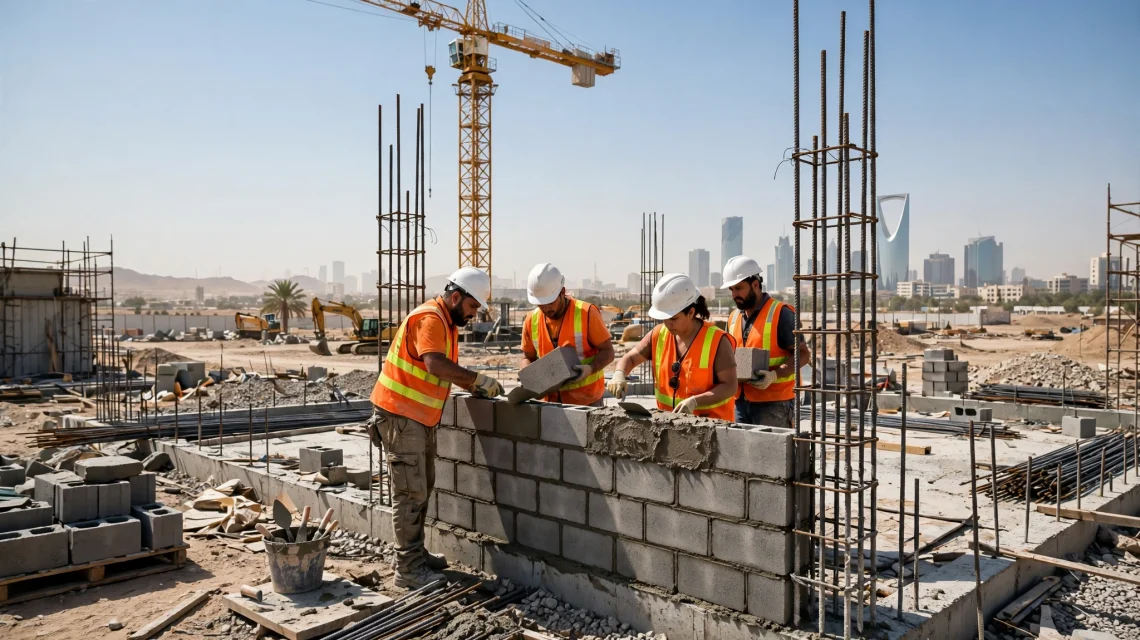
Hiring a construction worker in Riyadh is not one price. A general labourer for a villa clean-up, a mason for a blockwork crew and a scaffolder for a high-rise are three different hires at three different rates. Add the project, the duration and the work pattern, and the question becomes more useful: what does it cost to hire a construction worker on supply in Riyadh for your job?
The short answer: published Saudi manpower guides list indicative construction worker supply rates of SAR 11.50–19 per hour, depending on the trade — from a general labourer at SAR 11.50–16 per hour to a plumber or electrician at SAR 16–19 per hour. The exact rate is set by the trade, the number of workers, how long they are needed for and what is included in the supply rate. These figures are third-party estimates, not NR Dream Contracting prices — and a project-specific quote is the only way to know your true cost.
1. What does a “construction worker” cover?
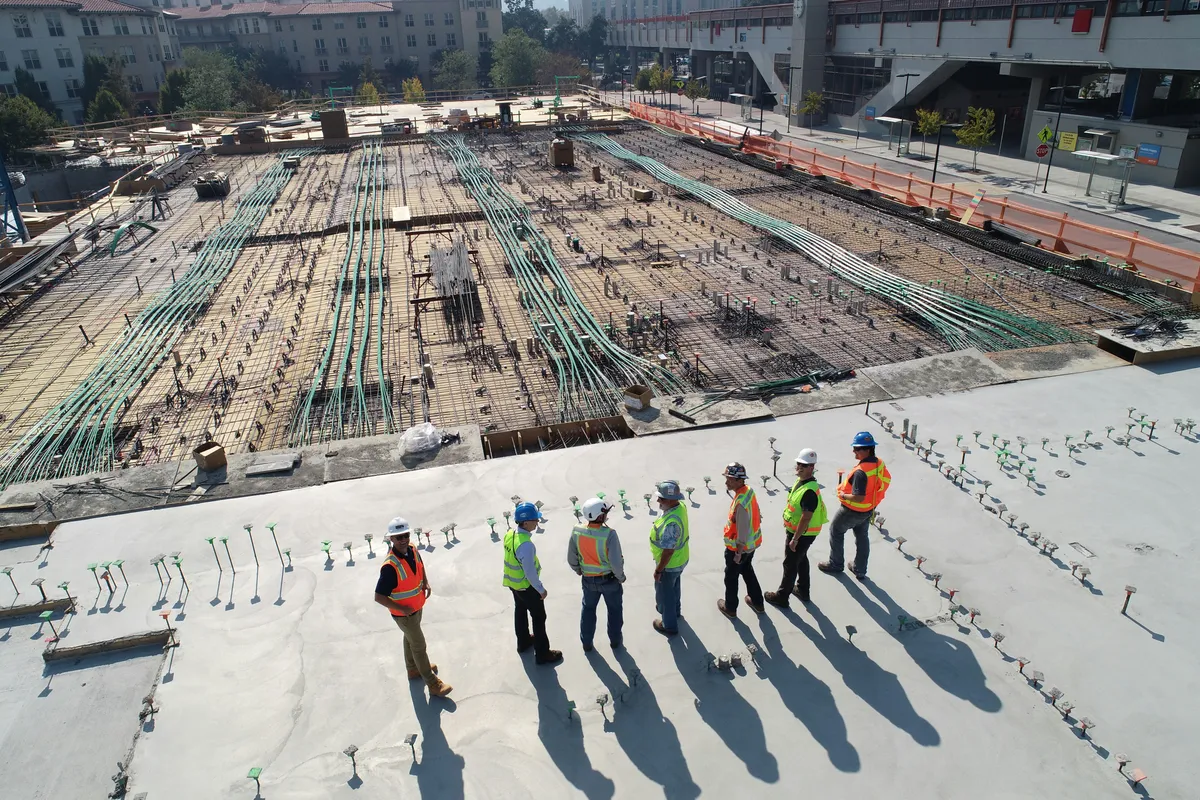
“Construction worker” is the umbrella term for the labourers and tradespeople who build, repair and maintain buildings — from general labourers and helpers to skilled tradespeople such as masons, steel fixers, carpenters, scaffolders, painters, plumbers and electricians. On a typical Riyadh project, the workers fall into five groups:
- A general labourer — site cleaning, moving materials, helping tradespeople and general site support. No trade qualification is usually required, so this is the lowest rate.
- A mason (block and plaster) — building blockwork, plastering, tiling and other finishing work. Quality matters here, especially on visible work.
- A steel fixer — cutting, bending and tying reinforcement steel for concrete work. This is skilled, physical work that determines structural quality.
- A scaffolder — erecting, inspecting and dismantling scaffolding. This is safety-critical, regulated work and usually requires certification.
- A finishing-trades worker (plasterer, painter, tiler or similar) — internal and external finishes. Rate depends on the finish quality, not just speed.
The rate follows the trade. A labourer is the cheapest; a certified electrician, plumber or scaffolder is more — and hiring the wrong worker for the job is the fastest way to get the wrong price, whether you overpay for a skilled worker on unskilled work or under-specify for work that needs training.
2. What is a one-off job vs hiring on supply?
Before comparing rates, be clear about which kind of hire you need, because the pricing model is different.
- A one-off construction job — a small repair, a wall, a paint job — is usually priced as a single job or a day rate, not by the hour.
- A construction worker supplied for a project or facility is priced by the hour, day or month under a manpower supply contract. The supplier provides the workers, handles their visa and iqama, provides accommodation and transport, and charges a supply rate that covers all of that plus a margin.
This guide is about the second model — hiring construction workers on supply for building, maintenance and industrial work in Riyadh.
3. Indicative construction worker supply rates in Riyadh (2026)
The table below brings together the published figures available for planning purposes. These are indicative third-party estimates, not fixed market rates and not NR Dream Contracting’s prices. If any figure below is not labelled ‘indicative’, treat it as indicative anyway — rates vary with trade, experience and project requirements.
| Trade | Indicative supply rate (SAR/hour) | Source |
|---|---|---|
| General labourer / helper | SAR 11.50–16 | Saudi manpower supply guide (Nov 2026) |
| Mason (block and plaster) | SAR 15–18 | Saudi manpower supply guide (Nov 2026) |
| Steel fixer | SAR 15–18 | Saudi manpower supply guide (Nov 2026) |
| Carpenter (shuttering) | SAR 15–18 | Saudi manpower supply guide (Nov 2026) |
| Scaffolder | SAR 16–19 | Saudi manpower supply guide (Nov 2026) |
| Plumber | SAR 16–19 | Saudi manpower supply guide (Nov 2026) |
| Electrician | SAR 16–19 | Saudi manpower supply guide (Nov 2026) |
| Painter | SAR 15–18 | Saudi manpower supply guide (Nov 2026) |
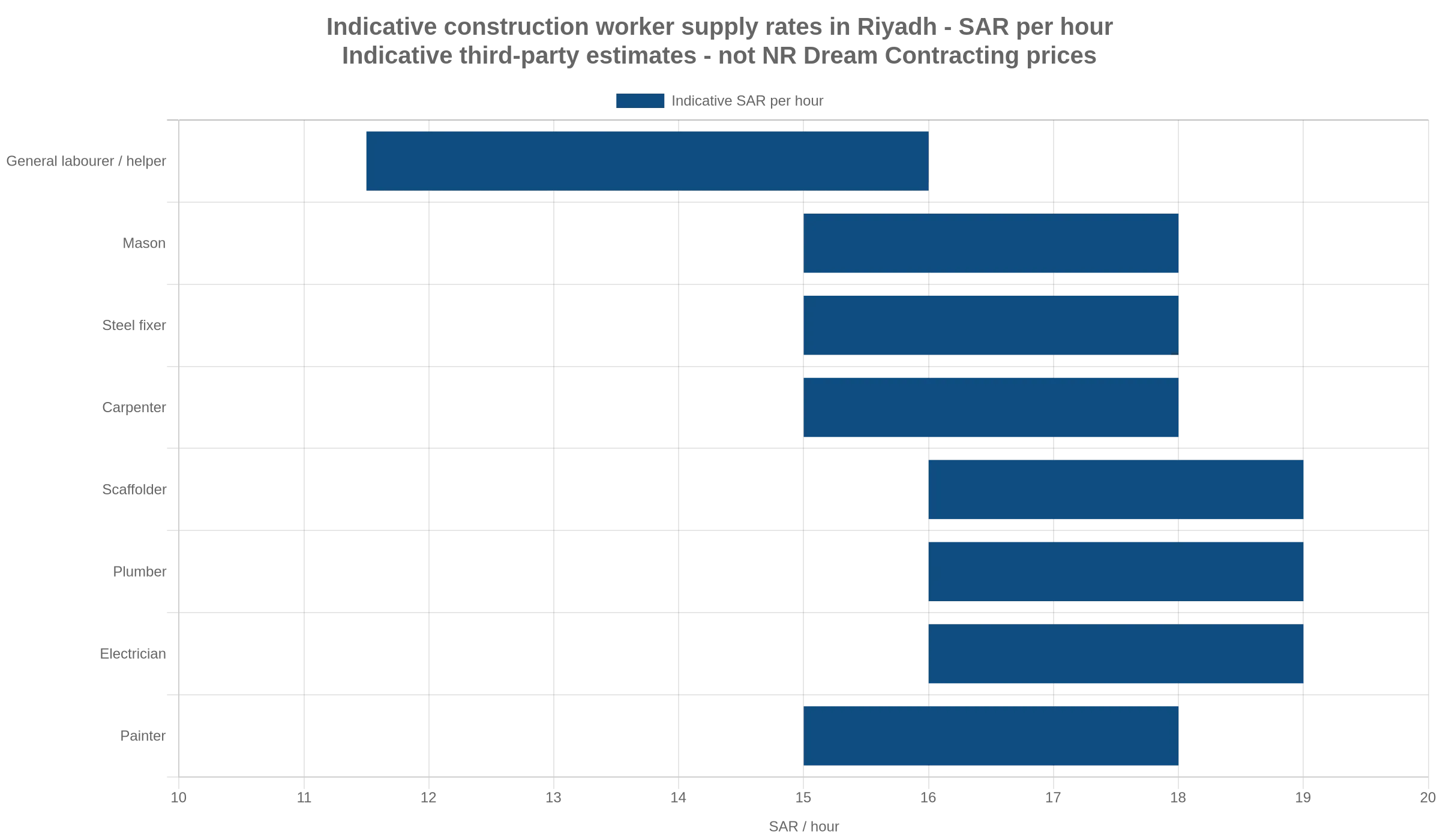
The figures come from a variety of sources — a general Saudi manpower guide, supply-rate listings and live job postings — and they are indicative only. They are not guaranteed to be current, they are not NR Dream Contracting’s prices, and they do not include any additional charges a supplier may apply.
In the companion cost guides, plumbers and electricians are covered in detail: see our electrician cost in Riyadh, plumber cost in Riyadh and welder cost in Riyadh guides. Individual trades also have their own salary pages: the national Saudi manpower guides list a general labourer at around SAR 1,500–2,500 a month and a construction worker at around SAR 2,000–3,500 a month, though those figures are earnings, not supply rates.
3.1. Why a supply rate is higher than a worker’s salary
Job listings advertise general labourers and construction workers in Saudi Arabia at roughly SAR 1,500–2,500 a month — around SAR 1,800 on average, with construction workers on a monthly wage at around SAR 2,000–3,500 a month. A supply rate is not a wage: a SAR 15 per hour supply rate covers a monthly wage, a visa and iqama, medical insurance, accommodation and transport, administration and a margin. Paying a worker SAR 1,800 a month is a very different cost from supplying him on site.
4. What makes one construction worker cost more than another
Six factors move the rate more than anything else:
- Trade and skill level. A scaffolder and a general labourer are not interchangeable. The more skill and certification a trade needs, the higher the supply rate.
- Experience and trade test. A worker with five years’ experience and a trade-test certificate costs more than a new helper — but he saves you the cost of rework.
- Headcount. Ten workers for six months prices differently from one worker for two weeks — volume and duration both change the rate.
- Contract length. A six-month deployment is cheaper per hour than a two-week emergency mobilisation, because the supplier can plan around it.
- Working hours and shifts. Night shifts, rotating shifts and regular overtime all add cost. Under Saudi Labour Law, overtime is paid at time-and-a-half, and the supplier passes that through.
- Site location. A project in central Riyadh has established transport routes and accommodation nearby; a remote industrial site does not — and the difference shows up in the rate.
5. What is usually included — and what is charged separately
Before you compare two quotes, check that they include the same things. A quote that looks cheap usually is not — the difference is in what it leaves out.
Usually included in a supply rate: the worker’s salary, work visa and iqama, medical insurance, accommodation, transport to and from site, Personal Protective Equipment (PPE), meals in some packages and a replacement if a worker leaves (check the terms).
Often charged separately — confirm in writing: overtime billing, mobilisation to a remote site, specialised PPE or consumables, project-specific training or permits and higher rates for approved or high-risk work.
6. How to get a quote — and what a supplier needs from you
A supplier cannot give you a firm rate from a job title alone. The more specific you are, the more accurate the quote — and the less likely the rate on your invoice differs from the rate you were quoted. Send the supplier:
- The work — trade, scope and expected quality (for example, “four masons for blockwork and plastering on a villa”, not “four workers”).
- Numbers and duration — how many workers, for how long, and whether the requirement will grow or shrink.
- Start date and site — when the workers need to be on site, where the project is and whether it is indoors or outdoors.
- Hours and shifts — normal hours, expected overtime and whether night work is involved.
- Accommodation and transport — whether the supplier provides it or you do, and any requirements for site access or safety passes.
If you cannot confirm details yet — for example, if the start date is undecided — say that. A supplier can quote a range and firm it up once the details are confirmed.
7. Compliance: iqama, skills tests and safety
Supplying a worker is not the same as selling labour. Whoever supplies the worker is responsible for their visa, iqama, work permit and insurance — and it is also where a project can fail an audit or a site safety inspection.
- Iqama and work permit — every worker supplied must have a valid iqama and be authorised to work in Saudi Arabia. This is not optional, and a supplier that cannot confirm it in writing is a risk.
- Skills tests — the Saudi Skill Verification Program, or SVP, covers manual trades in construction and requires workers to have been tested. For fixed works like scaffolding or electrical work, sites may require their own trade tests or certification before allowing workers on site, so check the programme or contract requirements before relying on an SVP certificate alone.
- Safety and PPE — all workers, including labourers and general workers, are required to wear PPE, and the supplier should provide it. For work at height or near electricity, specialised PPE and training may be charged separately.
Legitimate suppliers also screen the workers they send, check qualifications and trade-test certifiable trades before deployment, and usually have an iqama that allows the worker to work in Saudi Arabia. A supplier that cannot show you documentation for its workers is not saving you money; it is passing risk to you.
8. How to hire construction workers in Riyadh: five steps
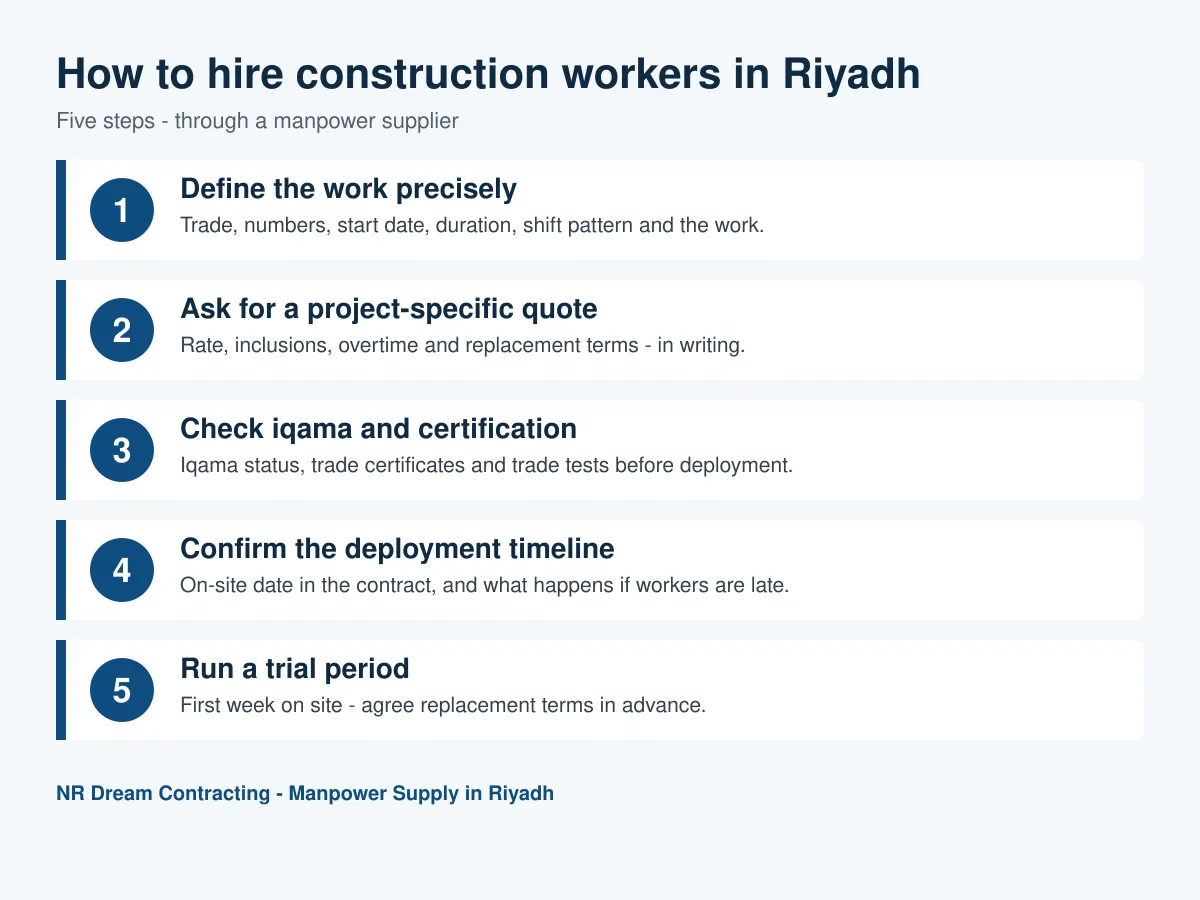
- Define the work precisely. Trade, number of workers, start date, duration, shift pattern and the work they will do. A vague brief returns a vague rate.
- Ask for a project-specific quote. Give the supplier the details from step 1 and ask for the rate, what is included, and the overtime and replacement terms in writing.
- Check iqama and certification before deployment. Ask for the workers’ iqama status and relevant trade certificates, and whether the supplier trade-tests. For scaffolders, electricians, plumbers and other certifiable trades, do not accept “we will check” after the workers arrive.
- Confirm the deployment timeline in the contract. Visa processing, testing and mobilisation take time — agree the date the workers will actually be on site, and what happens if they are late.
- Run a trial period. The first week on site tells you more than any certificate. Agree in advance what happens if a worker is not up to the job, and who pays for the replacement.
9. How to screen a manpower supplier
Before you hand over a project to a supplier, check the basics:
- Do they test and screen workers themselves, or pass through whoever applies? Ask to see the screening process and trade-test standard.
- Can they show iqama, insurance and certificates for the workers they propose? Documentation should be available before deployment, not after.
- What is the replacement policy? If a worker fails the site test or leaves mid-contract, how fast is the replacement and who pays for it?
- Are accommodation, transport and insurance inside the quoted rate? Get the inclusions in writing — a low rate with those excluded is not a low rate.
- Can they supply the headcount you need, on your dates? A supplier with five workers cannot staff a fifty-worker project.
10. Common mistakes when hiring construction workers in Riyadh
- Hiring on salary figures instead of supply rates. A SAR 1,800 monthly salary is what the worker earns, not what supplying him costs. Budget on the supply rate.
- Requesting workers without specifying the trade. “Construction worker” is not a trade — a blockwork crew needs masons, a steel crew needs steel fixers. Specify the trade.
- Skipping the trade test. A certificate proves a worker passed a test once. Your project’s trade test proves he can do your work now.
- Comparing quotes without comparing inclusions. The cheapest hourly rate with accommodation and transport excluded is often the most expensive quote.
- Leaving overtime and consumables out of the contract. Both are where supply invoices grow after the work starts.
- Starting mobilisation too late. Visas, SVP testing and approvals take weeks. Workers requested on Monday are not on site on Wednesday — leave a lead time.
11. Frequently asked questions
How much does it cost to hire a construction worker in Riyadh?
Indicative construction worker supply rates in Riyadh are published at around SAR 11.50–19 per hour, depending on the trade — from a general labourer at SAR 11.50–16 per hour to a plumber or electrician at SAR 16–19 per hour. The exact rate depends on the trade, the number of workers, how long they are needed for and what is included — so always get a project-specific quote rather than budgeting on a published figure. All figures in this guide are indicative third-party estimates, not NR Dream Contracting’s own rates.
What is the salary of a construction worker in Saudi Arabia?
Job listings put general labourers at roughly SAR 1,500–2,500 a month, and a construction worker at around SAR 2,000–3,500 a month — around SAR 1,800 a month on average for a general labourer. These are earnings, not the supply rate: a supply rate also covers visa and iqama, medical insurance, accommodation and transport, administration and a margin.
Can I hire a construction worker for a day?
It is possible, but it is not the usual supply model. Most suppliers set up a minimum period to cover visa and mobilisation costs, so a one-day hire is priced at a day rate or a minimum charge rather than a straight hourly rate — and it is also usually more expensive per hour than a longer deployment. For a very short requirement, ask the supplier for a day rate and check whether transport and PPE are included, and what happens if the worker cannot complete the work in one day.
How long does it take to deploy construction workers in Riyadh?
It depends on visa processing, trade testing and any project approvals required, and whether the workers are already on a local visa. Agree the on-site date in the contract, and confirm how quickly a replacement can be deployed if a worker fails a test or leaves.
Is it cheaper to hire workers directly or through a manpower supplier?
It depends on how the workers are deployed. For larger sites and longer contracts, manpower suppliers handle visa processing, trade testing, accommodation and transport, and manage one contract with one invoice — for many projects, that works out cheaper per worker. In short: labour hire through a supplier is usually less expensive than direct hiring when — for larger sites and longer contracts — workers are deployed by a manpower supplier, but direct hiring can look cheaper if you only need one or two workers for a short period and can carry the administration and compliance yourself.
Do construction workers in Saudi Arabia need a skills test?
Yes. The Saudi Skill Verification Program covers manual trades in construction — including common trades such as general construction work, and possibly scaffolding, electrical work and other certified trades — and requires workers to be tested before being deployed to a project. For fixed works like scaffolding or electrical work, sites may require their own trade tests or certification before allowing workers on site, so confirm the requirements before deployment.
12. Get a quote for construction workers in Riyadh
If you need construction workers for a construction, fit-out, maintenance or industrial project in Riyadh, tell us what you need — the trade, the number of workers, the start date, the hours and where the project is — and we will send a project-specific quotation. We aim to reply within one business day.
WhatsApp: +966568446980 · Phone: +966 55 141 5741 — or visit our construction workers page to see the full range of trades we supply. For other trades, see our electrician cost in Riyadh and plumber cost in Riyadh guides — and our overview of manpower supply companies in Riyadh.